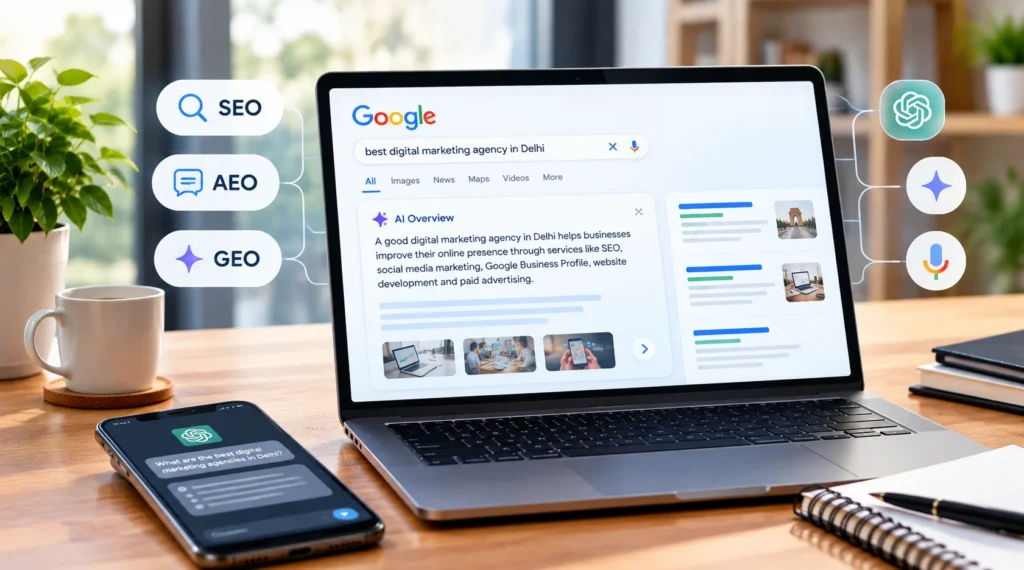
Search is changing. Earlier, people mainly searched Google and selected one of the displayed websites. Today, users can receive answers through search results, featured snippets, AI Overviews, voice assistants, ChatGPT, Gemini, Perplexity, and other AI-powered platforms.
This change has introduced terms such as SEO, AEO, and GEO. Although they sound different, all three are connected to one important objective: helping people discover useful information and businesses online.
Understanding the difference can help businesses prepare their websites and content for the changing search environment.
What Is SEO?
SEO stands for Search Engine Optimization. It focuses on improving a website so that its pages can appear in traditional organic search results.
SEO includes keyword research, content optimization, technical improvements, internal linking, local SEO, website structure, and authority-building activities.
For example, if a company provides website development services, it may create optimized pages around searches related to business websites, WordPress development, e-commerce websites, or website design.
The objective is to make the website relevant to searches performed by potential customers.
What Is AEO?
AEO stands for Answer Engine Optimization. Instead of focusing only on traditional rankings, AEO focuses on providing clear answers that search engines and answer-focused systems can easily understand and present to users.
People increasingly search using complete questions such as “How much does a business website cost?” or “How can I improve my Google Business Profile?”
AEO-friendly content should answer these questions clearly and directly.
Clear headings, concise explanations, FAQ sections, lists, structured information, and properly organized content can make information easier to understand and extract.
What Is GEO?
GEO generally refers to Generative Engine Optimization. It focuses on improving the chances of a brand or website being mentioned, referenced, or understood within AI-generated responses.
When someone asks an AI platform for recommendations or information, the system may use information from different sources to construct an answer.
This makes brand authority, useful content, consistent information, expert insights, and mentions across relevant websites increasingly important.
GEO is not simply about inserting keywords into content. It is about creating information that is clear, trustworthy, useful, and easy for AI systems to understand in context.
How Are SEO, AEO and GEO Connected?
These three approaches should not necessarily be treated as completely separate strategies.
SEO helps a website build traditional search visibility. AEO helps structure information around direct questions and answers. GEO focuses more broadly on visibility within generative search experiences.
There is considerable overlap between them.
For example, a detailed article about “How to Choose a Digital Marketing Agency” can be optimized for traditional search through keyword research and technical SEO. The same article can include direct answers to common questions for AEO and clear, authoritative information that may help generative systems understand the topic for GEO.
Why Content Structure Matters
Modern search systems need to understand information quickly. Long paragraphs without clear organization can make that difficult.
Businesses should therefore use descriptive headings, short paragraphs, bullet points, examples, FAQs, and logically organized sections.
Instead of writing a heading such as “Our Thoughts,” a business could use a more descriptive heading such as “How Does Local SEO Help Small Businesses?”
The second heading immediately communicates the topic and creates a clear question-answer structure.
Build Content Around Real Questions
One of the practical ways to improve search visibility is to understand what customers actually want to know.
Businesses can collect questions from sales calls, customer conversations, social media comments, Google searches, FAQs, and support messages.
These questions can then become website sections, service-page FAQs, blog articles, videos, or social media content.
This approach makes content more useful because it is based on real customer needs rather than simply producing articles around random keywords.
Don’t Ignore Traditional SEO
The growth of AI search does not mean businesses should abandon traditional SEO.
A strong website foundation still matters. Businesses should maintain technical health, create valuable content, use appropriate structured data, improve internal linking, and make important information accessible to users and search engines.
SEO, AEO, and GEO can work together as different parts of a broader visibility strategy.
Final Thoughts
The search experience is becoming more conversational and AI-driven, but the fundamental requirement remains the same: provide useful, clear, relevant, and trustworthy information.
Businesses that organize their websites around customer questions, strong content, technical quality, and consistent brand information can prepare themselves for multiple search environments.
Instead of choosing between SEO, AEO, and GEO, businesses can think of them as connected approaches to one larger goal: making their brand easier to discover, understand, and trust online.